
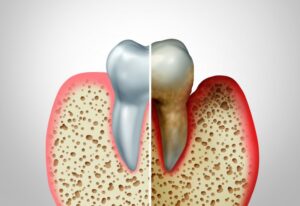
With as advanced as treatments and technology have become over the last several decades in the medical and dental fields, there are conditions that still don’t have full cures. Treatment can stop the disease in its tracks temporarily, but it may come back. While some of these infections can be minor like a cold, others can have serious, life-changing consequences. One issue that often is not taken seriously and goes unnoticed until it’s too late is gum disease. Learn how this disease can be controlled and treated in the content below.
Is There a Cure for Gum Disease?
It depends on when your gum disease has been diagnosed and to what stage the infection has progressed. The beginning signs of gingivitis, the first stage, may be easy to ignore with red, swollen, and easily bleeding gums, but at this point, the inflammation has not caused permanent damage yet, so it can be reversed and “cured.” However, later in development, gum disease is not considered “curable” because it leaves behind damage that can only be fixed with restoration or artificial materials and procedures. Just keep in mind that gum disease is treatable at any stage!
How Is Gum Disease Treated in Early Stages?
If you find your gums showing the symptoms of gingivitis, you can actually take care of the issue from home! Two brushing sessions and one flossing per day can keep plaque from attaching and hardening near the gumline. Everyone can make an occasional mistake, and in this case, anyone can miss some plaque now and then, which is why a regular checkup and professional cleaning are equally essential. The sooner the disease can be caught and resolved, the better!
How Is Gum Disease Treated in Late Stages?
When allowed to progress, gum disease causes the gum tissue to pull away from the teeth when bacteria detach the connection, in a process called recession. With easy access to the jawbone, the infection eats away at the jawbone’s density and structure. As a result, the teeth become less stable and eventually come out entirely.
To treat this more serious problem, several treatments can be used, including both non-invasive options and surgical procedures. Scaling and root planing are pretty standard, and this pairing involves a deep cleaning, going well below the gum line to scrape plaque and bacteria away, and making the rugged root surface slick and smooth so plaque struggles to reattach in the future.
For severe cases of jawbone damage, the best choice may be to extract teeth and start over with replacements. A bone graft or sinus lift may be necessary to give your bite more strength when you receive your restoration or implant restoration.
How Can You Prevent Gum Disease from Coming Back?
The excellent news is that getting reinfected or even contracting gum disease in the first isn’t inevitable. It actually can be prevented for a lifetime. It requires daily effort through brushing and flossing your teeth, consuming only a reasonable amount of sugar, and drinking more water.
Although there isn’t a permanent cure for gum disease, prompt treatment can preserve as much of your smile as possible. Even without an official cure, regular maintenance, both at home daily and with your dentist semi-annually, can shield you from unnecessary tooth loss in the future.
About the Author
At Central Perio, Dr. John Tunnell possesses expertise when it comes to identifying and treating gum disease. After earning his general dental degree, he completed a residency at the Texas A&M University Baylor College of Dentistry and became a board-certified periodontist. He is a member of many professional organizations like the American Academy of Periodontology, Texas Society of Periodontists, and others. If you would like to meet with Dr. Tunnell about gum disease or dental implants, reach out to our Dallas office online or call us for an appointment at 469-640-6730.